
Microsoft's cloud container continues to evolve. The company has unveiled the next generation of its data center container at its Windows Professional Developers Conference, and it includes significant design advances over the existing containers deployed in Microsoft's Chicago data center.
The 20-foot container on display at the PDC is an example of Microsoft's Generation 4 Modular Data Center design, which abandons the raised-floor architecture that has been a staple of modern data center design in favor of a container-based model. Microsoft says the use of server-packed containers - known as Pre-Assembled Components (PACs) - will allow it to slash the cost of building its new data centers, which will have no roofs.
Optimized for Outdoors?
The Generation 4 container on display at PDC looks to be completely optimized for outdoor use, with a design that relies upon fresh air ("free cooling") rather than air conditioning. While we're not on-site at PDC and haven't been able to inspect the container, it features louvers on the exterior of the container to draw fresh air into the cold aisle and expel hot air from the rear of the hot aisle.
UPDATE: Microsoft's Bob Muglia has more on the design. " Ambient air is drawn over a membrane onto which a small amount of water is released," Muglia tells InformationWeek. "I think it's two gallons an hour. The slow release of water drops the temperature of ambient air coming in through a system of louvers by 20 or 25 degrees and that's sufficient to keep the servers cool enough. "
Here's a look at a video of the container shot by a PDC attendee:
The container features the branding for Windows Azure, Microsoft's developer-focused cloud computing platform. Windows Azure will run at facilities in Chicago, San Antonio, Dublin, Amsterdam, Singapore and Hong Kong.
This is a departure from the current Microsoft container design, which features one container filled with IT gear and another holding the power and cooling infrastructure. Here's a look at one of the double-decker data center containers currently in use at Microsoft's Chicago data center:
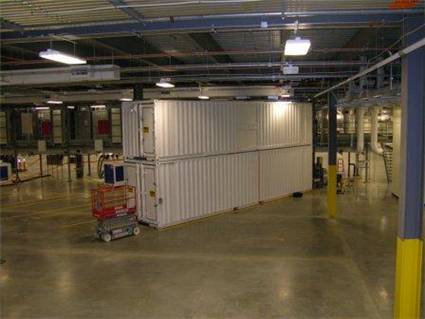
Microsoft's $500 million Chicago facility uses a hybrid design built around data center containers. The lower level is a vast space with a high ceiling and diagonal parking spaces for the 40-foot container stacks.
The first phase of the 700,000 square foot facility can hold up to 56 containers, and a second phase (currently shell space) offers identical capacity. That gives the Chicago facility a total capacity of 112 containers holding 224,000 servers.
In laying out its Generation 4 design, Microsoft said its future data centers would require no water and have no roofs. The company says the new design may reduce capital investments by 20 to 40 percent by creating a “competitive and innovative supplier landscape.” It is also designed to accelerate Microsoft’s data center deployment process, shrinking the timeline from 18 months to as little as three to six months.
RELATED STORIES:


