
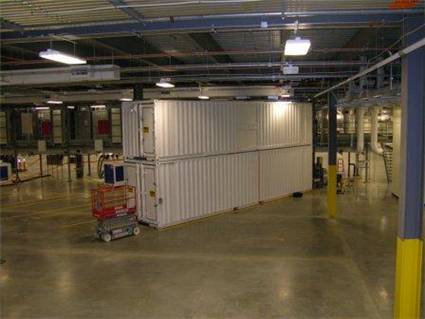
A look at one of the double-decker data center containers housed at the massive new Microsoft data center near Chicago. The facility includes both raised-floor space and plug-n-play bays for containers packed with servers.
As the bay door opens at Microsoft's enormous new Chicago data center, the future backs in on a trailer. Forty-foot long containers packed with servers are unloaded with winches, and stacked two-high onto "air skates" that float on compressed air. Using the air skates, as few as four employees can move the 60-ton stack into place in Microsoft's "container canyon" in the lower floor of the facility in Northlake, Ill.
Within eight hours, the new container is fully installed, hooked up to chilled water, power and a network connection. "These hold 2,000 servers each, and they can be deployed in hours," said Kevin Timmons, Microsoft's general manager for data center operations. "That's an awesome, awesome thing."
$500 Million Investment
Microsoft opened the doors of its $500 million Chicago facility today, providing media and local officials with a look inside the 700,000 square foot data center. The tour showcased a container-driven design that Microsoft expects to deliver huge benefits in cost, energy efficiency and environmental sustainability. (See our photo tour for a closer look at the new facility).
The new data center, which began operations on July 20, is an unusual hybrid of what Microsoft views as the present and future of data center design, separated by a staircase.
The lower level is a vast space with a high ceiling and diagonal parking spaces for the 40-foot container stacks. Twelve containers are already installed, including 10 double-stacked versions with servers on the bottom and cooling infrastructure above, and two single-story containers.
The first phase can hold up to 56 containers, and a second phase (currently shell space) offers identical capacity. That gives the Chicago facility a total capacity of 112 containers holding 224,000 servers.
"We think of the containers as a revolutionary approach to computing at scale," said Arne Josefsberg, General Manager of Infrastructure for Microsoft Global Foundation Services. "This is just a massive facility that will allow us to meet the demand for cloud computing at scale."
Raised-Floor Space on Upper Level
The second floor of the enormous facility features traditional raised-floor data center space using hot and cold aisles. The upstairs area includes space for four 12,000 square foot pods of raised-floor space, enough to support tens of thousands of additional servers to power Microsoft's “Live” suite of online services.
The raised-floor area is fed by a cooling loop filled with 47-degree chilled water, while the container area is supported by a separate chilled water loop running at 65 degrees. Of the facility's total 30-megawatt power capacity, about 20 megawatts is dedicated to the container area, with about 10 megawatts for the raised floor pods. The power infrastructure also includes 11 power rooms and 11 diesel generators, each providing 2.8 megawatts of potential backup power that can be called upon in the event of a utility outage.
Focus on Economization
While Microsoft's new Dublin facility uses air-side economization in its cooling systems, the Chicago site employs water-side economization. Both techniques take advantage of cool outside air to reduce the data center's reliance upon power-hungry chillers to produce chilled water. Air economizers introduce fresh air into the data center, while water-side economizers use cooling towers to remove waste heat.
The Chicago data center has 12 large chillers on site, but will only use them when the temperature is too warm to use economization.
Josefsberg said that although some in the data center industry might be surprised by Microsoft's decision to show off its new technology and design, Josefsberg said the company's focus on sustainability demands it. "We really think it's important to share what we've learned," he said.
Data Center Knowledge will have additional coverage of Microsoft's Chicago facility open in coming days. Watch this space for more. You can stay current on the latest data center news by subscribing to our RSS feed and daily e-mail updates.
RELATED POSTS:


