• Google CapEx Edges Higher in Q4

    January 22nd, 2010 : Rich Miller

    Google (GOOG) invested $221 million on its data centers in the fourth quarter of 2009, a slight uptick from the $186 million it spent in the third quarter. But Google’s infrastructure costs remained well below the levels seen during the company’s expansion years in 2006-2007. The company has not announced any new data center builds in the U.S. since June 2007, and confirmed just one international project in 2009 in Hamina, Finland. Here’s a look at the recent trend in Google’s capital expenditures: 

    Google-CapEx-4Q2009

    • 1Q 2006: $345 million
    • 2Q 2006: $699 million
    • 3Q 2006: $492 million
    • 4Q 2006: $367 million
    • 1Q 2007: $597 million
    • 2Q 2007: $575 million
    • 3Q 2007: $553 million
    • 4Q 2007: $678 million
    • 1Q 2008: $842 million
    • 2Q 2008: $698 million
    • 3Q 2008: $452 million
    • 4Q 2008:$368 million
    • 1Q 2009: $263 million
    • 2Q 2009: $139 million
    • 3Q 2009: $186 million


    The capex “breather” has been enabled by the company’s building boom in 2007-08, during which it announced major data center construction projects in Lenoir, North Carolina; Goose Creek, South Carolina; Pryor, Oklahoma and Council Bluffs, Iowa.

    After the economic meltdown gripped Wall Street last fall, Google throttled back spending even further, opting to delay construction of its data center in Pryor.

    Read More »
  • Google Leases More Space at 111 Eighth Ave.

    January 19th, 2010 : Rich Miller

    Google has leased another 57,000 square feet of space at 111 Eighth Avenue, according to the New York Observer. This is in addition to the 270,000 square feet of space the company leased back in 2005. New York media have been intrigued with Google’s large presence in the building, but all reports indicate that the company’s leased space is used for business and sales operations.

    That’s somewhat curious, since 111 Eighth Avenue is also one of the most wired carrier hotel properties in New York, and a key intersection for the Internet’s largest networks. Peering records show that Google participates in public peering at the NYIIX exchange, which operates in Switch and Data’s PAIX facility at the building, but there are not indications that Google operates one of its own data centers at the site. But plenty of other companies do.

    111 Eighth Avenue was built in 1932 as the Port Authority Commerce Building. It is the third-largest building in New York City with 2.8 million square feet. New York’s Google office is located here along with many other large companies including MCI, Sprint, Level 3, Qwest, Switch and Data, Digital Realty Trust and Telx.

    Read More »
  • Google’s Servers, Behind the Great Firewall

    January 13th, 2010 : Rich Miller

    Many hosting companies are interested in the huge market of users in China. But most have been reluctant to physically locate data centers on the Chinese mainland due to concerns about the government’s policies on Internet monitoring and censorship. Instead, most hosting and colocation companies have opted to place their data centers in the region in Hong Kong or Singapore.

    Several recent examples: Among cloud computing companies expanding in the region, Salesforce.com (CRM) opened a new data center in Singapore, while Rackspace (RAX) chose to expand in Hong Kong.

    The location issue is likely to remain relevant in the wake of Google’s disclosure last night that it may be forced to shut down its operations in China. Google cited “a highly sophisticated and targeted attack on our corporate infrastructure originating from China” in announcing its plans to review its Google.cn operations.

    Google doesn’t say much about its data centers, but has acknowledged that it houses its servers for Google.cn inside China, behind the “Great Firewall” of monitoring and filtering. “In order to enter China, we needed to comply with the Chinese laws, which means our servers need to be located in China and that our content, our search results, would be filtered, per local law and regulation,” Google’s Kai-Fu Lee told PBS in 2008.

    Read More »
  • Will Google Energy Power Its Data Centers?

    January 7th, 2010 : Rich Miller
    A look at a working solar thermal power generation facility.

    A look at a working solar thermal power generation facility.

    Google (GOOG) has formed a new subsidiary to buy and sell power on the wholesale market, and hopes the move will help provide more renewable energy to meet its corporate carbon reduction goals. The company formed Google Energy last month and has asked the Federal Energy Regulatory Commission (FERC) to allow it to participate in the energy markets.

    “Right now, we can’t buy affordable, utility-scale, renewable energy in our markets,” Google representative Niki Fenwick told CNet. “We want to buy the highest quality, most affordable renewable energy wherever we can and use the green credits.”

    Target: Data Centers?
    Google isn’t saying how it will use any green energy it generates or purchases, but the company’s vast, power-hungry data center network could be the primary beneficiary. Google has shown an intense focus on energy efficiency in the design and operation of its data centers, and has also invested in renewable energy, primarily through its Google.org non-profit arm.

    Read More »
  • Can the ‘Google Economy’ Lift Small Towns?

    December 17th, 2009 : Rich Miller

    Earlier this week we looked at how data centers have boosted the fortunes of the small town of Quincy, Washington. This week NPR is examining another small town that provides a window into the potential of data centers as an economic development tool, and the challenges faced by local residents hoping to win high-paying jobs at these facilities. 

    NPR’s Frank Langfitt looks at the changing fortunes of Lenoir, North Carolina, a town in Caldwell County which is perhaps best known as the home of a $600 million data center for Google. Google’s arrival in 2007 was hailed as a transformative event for Lenoir, which was once known as the “Furniture Capital of the South” but has seen two-thirds of its furniture workers lose their jobs as the industry shifted production to China.   

    Can former furniture workers find jobs at Google? Many Lenoir residents have gone back to school at the local community college to learn IT skills in hopes of being hired by Google. You can listen to the first installment of the three-part series on the NPR web site.  The series will continue this week on NPR’s evening news program, All Things Considered.

    Read More »
  • Google Exploring Quantum Computing

    December 14th, 2009 : Rich Miller
    A view of an earlier version of D-Wave qubit processor (Photo by J. Chung, D-Wave Systems Inc.).

    A view of an earlier version of D-Wave qubit processor (Photo by J. Chung, D-Wave Systems Inc.).

    Google is working on developing a quantum computer, a technology that could dramatically enhance the power of its search capabilities. The company revealed last week that it has spent three years developing a quantum algorithm, and is collaborating with Canadian company D-Wave, which is working to build quantum computing processors.

    What is quantum computing? Here’s a description from Popular Science: “The promise of quantum computing rests with the bizarre physics that occurs at the subatomic level. Different research teams have worked on creating quantum processors that store information as qubits (quantum bits), which can represent both the 1 and 0 of binary computer language at the same time. That dual possibility state allows for much more efficient processing and information storage.”

    Google’s announcement that it has figured out how to use quantum algorithms to sort images is covered by New Scientist and Popular Science. Will this technology eventually help Google in its bid to organize the world’s information? How might a successful implementation of quantum computing affect the company’s use of data centers?

    “There are still many open questions but in our experiments we observed that this detector performs better than those we had trained using classical solvers running on the computers we have in our data centers today,” writes Google’s Hartmut Neven.

    Read More »
  • Google, Cables and the Future of the Web

    December 14th, 2009 : Rich Miller

    Why is Google investing in a second undersea telecommunications cable project? For Google, this move is all about the future of the Internet and laying the foundations for an infrastructure that will track the network’s growth. 

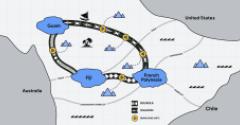
    Last Thursday Google said it would team with KDDI, Bharti Airtel, Reliance to build a $400 million submarine cable that will connect the Asia Pacific region, dubbed Southeast Asia Japan Cable (SJC). In 2008 Google announced a deal to partner with Bharti Airtel, Global Transit, KDDI Corp., Pancet and SingTel on the $300 million Unity Trans-Pacific Cable.

    To understand the motivations behind Google’s investment, check out this July video of a presentation by Google’Chief Internet Evangelist Vint Cerf, during which he discusses growth trends in Internet usage. At about the 9 minute mark, Cerf notes that Asia already has the largest Internet population, with 657 million users, compared to 393 million in Europe and 251 million in North America. Here’s the key data point: when expressed in percentage of the population, 75 percent of North Americans are online, compared to 49 percent of Europeans. In Asia, that 657 million represents just 17 percent of the population.

    Read More »
  • Google Patent Reveals Data Center Innovations

    November 30th, 2009 : Rich Miller
    A diagram of an "air wand" indicating the location of cooling vents in wand, a key feature of a patent application by Google data center engineers.

    A diagram of an "air wand" indicating the location of cooling vents in the wand, a key feature of a patent application by Google data center engineers.

    Google has revealed some of the secret technology inside its mighty data centers, but its engineers are busy cooking up new secrets.

    An example: Google is seeking to patent an advanced data center cooling system that provides precision cooling inside racks of servers, automatically adjusting to temperature changes while dramatically reducing the energy required to run chillers.

    The cooling design, which could help Google slash the power bill for its servers, reinforces Google’s focus on its data centers as a competitive advantage in its battle with Microsoft and other rivals for leadership in cloud computing. The company has customized much of the operation of its data centers, which serve as the engines powering its massive Internet business. Google builds its own servers and networking switches, and now appears to be customizing the racks that hold them.

    Precision Cooling via ‘Air Wands’
    The innovative rack cooling design features an adjustable piping system, including “air wands” that provide small amounts of cold air to components within a server tray. The chilled air enters the top of a rack through two vertical standpipes, which branch off into air wands – long, thin pipes lined with vents that release cold air.

    The air wands can pivot to target cold air on specific components, or be swung to one side to allow equipment to be removed from the rack. Dampers on each standpipe can open and close to regulate the volume of air flowing into the pipe and air wands, while the vents on each individual air wand can be adjusted to point up or down, allowing for a highly configurable system. (See A Closer Look at Google’s New Cooling Design for a diagram).

    Read More »
  • Should Servers Come With Batteries?

    November 27th, 2009 : Rich Miller

    Will the data center of the future have no central UPS units, and be filled with servers with on-board batteries? The data center team at Facebook believes it should, and is pledging to share its best practices - and perhaps wield some of its clout with vendors and data center operators - as it presses its case for change.   

    Facebook recently disclosed its plans to adopt a novel power distribution design pioneered by Google that removes uninterruptible power supply (UPS) and power distribution units (PDUs) from the data center. The new design shifts the UPS and battery backup functions from the data center into the cabinet by adding a 12 volt battery to each server power supply.

    While many best practices shared by Google, Microsoft and Facebook can help other data center operators save energy and money, other customizations are impractical.   

    Big Companies, Big Innovation 
    “A lot of the innovation in the field is being driven by companies with thousands of servers who really care about the efficiency of these things,” said Facebook’s Amir Michael, who previously worked on Google’s data center team. “We have capital to be able to afford engineers to solve these problems. It’s not really benefiting the rest of the industry. Smaller companies who might deploy fewer servers can’t go and design their own systems.”

    In discussing Facebook’s plans for on-board batteries, Michael discussed ways these innovations might become more widely available.

    Read More »

ARCHIVED ARTICLES

All Content on Data Center Knowledge
© 2009 Miller Webworks LLC
All Rights Reserved