
• A Look Inside Amazon’s Data Centers

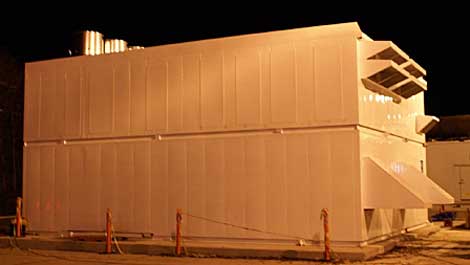
    A look at the Amazon Perdix container, included in a presentation at Amazon Technology Day.

    Amazon Web Services doesn’t say much about the data centers powering its cloud computing platform. But this week the company held a technology open house in Seattle, where AWS Distinguished Engineer James Hamilton discussed the company’s infrastructure. The presentation (PDF) included an image of a modular data center design used by Amazon, which is the first official acknowledgement that the company uses modular infrastructure.

    Hamilton also shared a factoid that provides a sense of the rapid growth of Amazon’s cloud platform. “Every day Amazon Web Services adds enough new capacity to support all of Amazon.com’s global infrastructure through the company’s first 5 years, when it was a $2.76 billion annual revenue enterprise,” Hamilton states in one of the slides.

    Growth Driving Data Center Expansion Plans

    Even without the exact numbers, that’s an indicator of how rapidly Amazon’s infrastructure is growing, and why the company has recently began acquiring additional sites in Ireland, northern Virginia and Oregon for data center expansion.

    In his research at Microsoft and now at Amazon Web Services, Hamilton has focused on cost models for operating hyper-scale data centers. His presentation at the Amazon open house reviewed cost assumptions for an 8 megawatt data center, which could include 46,000 servers.

    Hamilton estimated the cost at $88 million (about $11 million per megawatt), and presented a pie chart outlining monthly operating costs for a facility, which is dominated by the cost for servers (57 percent), followed by power and cooling (18 percent) and electric power (13 percent).

    These percentages are consistent with Hamilton’s earlier published research on data center costs. His example assumes power costs of roughly 7 cents per kilowatt hour and a Power Usage Effectiveness (PUE), which both suggest that the example data center is a composite  of Amazon’s global footprint rather than its best-performing data center.

    Amazon and Modular Design

    Hamilton was an early advocate of using shipping containers to deploy large volumes of servers in a tightly-controlled environment, first discussing this approach in a series of 2007 presentations that preceded Microsoft’s decision to use modular units to deploy its cloud computing infrastructure. When Hamilton moved to AWS, it prompted speculation that Amazon might also be using containers.

    At Tuesday’s open house Hamilton displayed a slide of modular data centers, including the Amazon Perdix. The unit appears to be a custom-built unit that is wider and taller than standard ISO containers. While it’s hard to glean much from the exterior, vents at the side and top suggest cooling is managed in the upper section of the unit, which is air-cooled. Why Perdix? It’s the name of a character in Greek mythology known for inventing useful tools.

    Is this Amazon’s current technology? Perhaps not. An Amazon affiliate that builds the company’s data centers has submitted building plans for a new facility in Umatilla, Oregon featuring six modules, according to local media. Plans show the structures will be about 20 feet wide and 108 feet long, situated side by side on the property, according to the East Oregonian.

    Amazon continues to deploy infrastructure on raised floor, as seen in this photo shared by Hamilton.
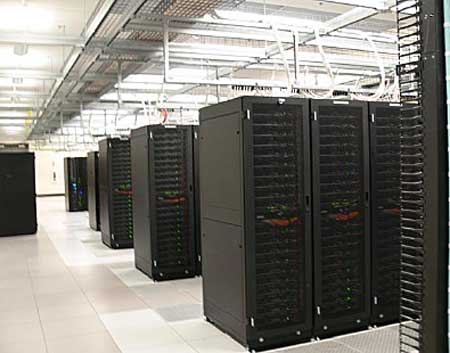
    A slide of a data center from a presentation at the Amazon Technology Open House.

    About

    Rich Miller is the founder and editor-in-chief of Data Center Knowledge, and has been reporting on the data center sector since 2000. He has tracked the growing impact of high-density computing on the power and cooling of data centers, and the resulting push for improved energy efficiency in these facilities.

  • Sign up for the Data Center Knowledge Newsletter

    Get daily email alerts direct to your inbox.

    [...] Data Center Knowledge [...]

    jmuniz

    Posted June 13th, 2011

    “Power Usage Effectiveness of PUE” does not make sense.

    Michael W. Perry

    Posted June 13th, 2011

    I was also at that presentation. If you listened carefully, the growth statistic had a small caveat. It was based on a five-day work week. Each seven-day week, Amazon adds five times the capacity it had in 2000. Still very impressive.

    He also noted one reason: cost. There is intense competition in the server and CPU industries, which is driving costs down very quickly, along with an economy of scale. Doubling capacity doesn’t double costs.

    He also had some interesting things to say about cooling costs, including the feasibility of using unrefrigerated outside air even when outside temperatures are high. Which is cheaper, cooling costs are a higher failure rate? He also mention the possibility, in perhaps 5-10 years, of using that waste heat for other purposes, including growing food in cool climates.

    All in all, it was an interesting presentation. We can hope Amazon does more of them and perhaps posts videos online much like Google does for TED.

    Chris

    Posted June 13th, 2011

    It’s a measure of how effective and awe-inspiring the acronym PUE is within an article.

    mk2005

    Posted June 13th, 2011

    very large system. but i think google serverr better.

    Doc

    Posted June 13th, 2011

    Neatacularistic.

    I’ve been using the free tier of AWS for a few months, not too shabby. Granted, I’m unsure who I’d get support from if I ever needed it.. Aside from googling around.

    [...] A Look Inside Amazon’s Data Centers « Data Center Knowledge. Share [...]

    [...] in technology infrastructure necessary to support AWS – like the huge data centers that Amazon is adding to its footprint. As James Hamilton, P Distinguished Engineer, Amazon Web Services, explained in [...]

    [...] company has been stating recently that, “Every day Amazon Web Services adds enough new capacity to support all of [...]

    How Low Can Cloud Pricing Go?

    Posted June 30th, 2011

    [...] company has stated recently, “Every day Amazon Web Services adds enough new capacity to support all of Amazon.com’s global [...]

    [...] each of these regional datacentres is believed to be quite large. An article published by very useful site Data Center Knowledge just last week tells us just how large they are — $88 million per month for 8MW worth of [...]

    [...] any of these informal datacentres is believed to be utterly large. An essay published by unequivocally useful site Data Center Knowledge usually final week tells us usually how immeasurable they are — $88 million per month for 8MW [...]

    [...] is heavily investing in data center infrastructure. Capital expenditures in Q1 2011 were about $300 million, including investments in technology [...]

    [...] is heavily investing in data center infrastructure. Capital expenditures in Q1 2011 were about $300 million, including investments in technology [...]

    [...] is heavily investing in data center infrastructure. Capital expenditures in Q1 2011 were about $300 million, including investments in technology [...]

    [...] energy is accessible ad hoc over a internet. Amazon, for instance, now adds roughly as most computing energy per day to a cloud computing systems as it used to need for all a site in 2000. Other companies are doing a [...]

    [...] power is available ad hoc over the internet. Amazon, for instance, now adds almost as much computing power per day to its cloud computing systems as it used to need for all its site in 2000. Other companies are [...]

    [...] power is available ad hoc over the internet. Amazon, for instance, now adds almost as much computing power per day to its cloud computing systems as it used to need for all its site in 2000. Other companies are [...]

    [...] wedge of the US energy consumption pie chart: data centers and their customers?  Google, Amazon, and their midstream kin are all working hard at improving their efficiency, including funding [...]

    [...] IP addresses – he then extrapolated, came up with estimates on the number of racks in each data center location and took into account the number of blade servers per rack, to come up with his [...]

    [...] power is available ad hoc over the internet. Amazon, for instance, now adds almost as much computing power per day to its cloud computing systems as it used to need for all its site in 2000. Other companies are [...]

    [...] stored 762 billion objects in its S3 storage cloud last year — three times the 2010 tally. Another favorite: Amazon says that “Every day Amazon Web Services adds enough new capacity to support all of [...]

    Add Your Comments

      RESOURCE LINKS:

Sign up for the Data Center Knowledge Newsletter

Get daily email alerts direct to your inbox.

ARCHIVED ARTICLES