
• Google’s Chiller-less Data Center

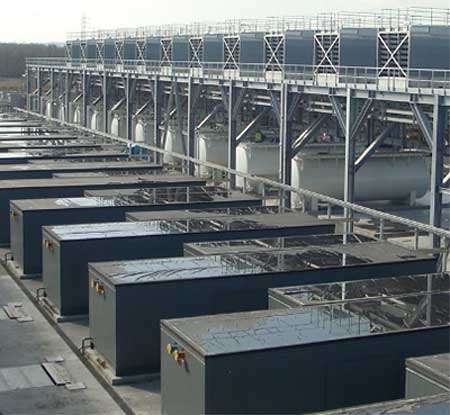
    The equipment yard at the Google data center in St. Ghislain, Belgium features no chillers. (Photo from Google)

    The equipment yard at the Google data center in Belgium features no chillers. (Photo from Google)

    Google (GOOG) has begun operating a data center in Belgium that has no chillers to support its cooling systems, a strategy that will improve its energy efficiency while making local weather forecasting a larger factor in its data center management.

    Chillers, which are used to refrigerate water, are widely used in data center cooling systems but require a large amount of electricity to operate. With the growing focus on power costs, many data centers are reducing their reliance on chillers to improve the energy efficiency of their facilities.

    This has boosted adoption of “free cooling,” the use of fresh air from outside the data center to support the cooling systems. This approach allows data centers to use outside air when the temperature is cool, while falling back on chillers on warmer days.

    Google has taken the strategy to the next level. Rather than using chillers part-time, the company has eliminated them entirely in its data center near Saint-Ghislain, Belgium, which began operating in late 2008 and also features an on-site water purification facility that allows it to use water from a nearby industrial canal rather than a municipal water utility.

    Year-Round Free Cooling
    The climate in Belgium will support free cooling almost year-round, according to Google engineers, with temperatures rising above the acceptable range for free cooling about seven days per year on average. The average temperature in Brussels during summer reaches 66 to 71 degrees, while Google maintains its data centers at temperatures above 80 degrees.

    So what happens if the weather gets hot? On those days, Google says it will turn off equipment as needed in Belgium and shift computing load to other data centers. This approach is made possible by the scope of the company’s global network of data centers, which provide the ability to shift an entire data center’s workload to other facilities.

    In a March interview, Urs Holzle, Google’s Senior Vice President of Operations, said the company typically uses manual tools to manage data center level outages and downtime.  “Teams regularly practice failing out of or routing around specific data centers as part of scheduled maintenance,” he said. “Sometimes we need to build new tools when new classes of problems happen.”

    Redirecting Workloads Instantly
    At last month’s Structure 09 conference, Google’s Vijay Gill hinted that the company has developed automated tools to manage data center heat loads and quickly redistribute workloads during thermal events (a topic covered by The Register). 

    “You have to have integration with everything right from the chillers down all the way to the CPU,” said Gill, Google’s Senior Manager of Engineering and Architecture. “Sometimes, there’s a temperature excursion, and you might want to do a quick load-shedding to prevent a temperature excursion because, hey, you have a data center with no chillers. You want to move some load off. You want to cut some CPUs and some of the processes in RAM.”

    Gill was asked if this was a technology Google is using today. “I could not possibly comment on that,” Gill replied.

    Look Ma: No Chillers!
    But Google engineers had already disclosed the existence of the chiller-less Belgium data center at the Google Data Center Efficiency Summit in April in Mountain View, Calif. At the event, we asked specifically: are there chillers on-site that are rarely used, or no chillers at all?

    The answer: no chillers at all. The facility will rely entirely on free cooling, and redirect workload on days when it’s too hot to operate. This approach makes local weather an issue in network management, although advanced forecasting can help Google anticipate days when it may need to divert work from the Belgium facility.

    Nonetheless, even Google is periodically challenged by rerouting entire data centers, as seen in a February Gmail outage when a data center was overloaded while shifting workloads. Traffic redirection was also an issue in a brief outage in May.      

    An Enabler for “Follow the Moon”?
    The ability to seamlessly shift workloads between data centers also creates intriguing long-term energy management possibilities, including a “follow the moon” strategy which takes advantage of lower costs for power and cooling during overnight hours. In this scenario, virtualized workloads are shifted across data centers in different time zones to capture savings from off-peak utility rates. 

    This approach has been discussed by cloud technologists Geva Perry and James Urquhart as a strategy for cloud computing providers with global data networks, who could offer a “follow-the-moon” service to enterprise customers who would normally build data centers where power is cheap. But this approach could also produce energy savings for a single company with a global network – someone like Google.

    About

    Rich Miller is the founder and editor-in-chief of Data Center Knowledge, and has been reporting on the data center sector since 2000. He has tracked the growing impact of high-density computing on the power and cooling of data centers, and the resulting push for improved energy efficiency in these facilities.

  • Sign up for the Data Center Knowledge Newsletter

    Get daily email alerts direct to your inbox.

    In The Tech News « Caintech.co.uk

    Posted July 15th, 2009

    [...] How to Get Hired at Fog Creek, Part 1 Tim Ferriss’ New Book: Become a Superhuman Google’s Chiller-Less Data Center Apollo 11 in Pictures Company fined $300,000 for posting fake reviews online Announcing: The Zed [...]

    Steve O'Donnell

    Posted July 15th, 2009

    Try moving the petabytes that go with an enterprise data center out of Belgium. It’s OK for Google but not a universally viable solution in the enterprise.

    Bottom line is we need to reduce the deltaT (difference in temperature) between ambient outside and Tcase – (the chip case temperature). Air can’t do it above 35 degrees C (thats 100 F). Liquid can work up to 45 degrees C (120 F) ambient with free cooling – no refrigeration.

    A small UK based firm – Iceotope just filed all the patents on how to do it cheap and repeatable. Beta build started.

    Steve

    Sump Pump

    Posted July 15th, 2009

    A data center in Antarctica with a sufficiently large fiber link is inevitable. There’s no precipitation. Just leave the roof off and you’ve got all the cooling you’ll require.

    Global Warming

    Posted July 15th, 2009

    yeah..no precipication…except for global warming…..bye bye to the data centres…. :) hey..wait my data center is under water now…..albeit,….really really cold!!!!!! probably colder than needed….and more wet than needed as well…

    Skaperen

    Posted July 16th, 2009

    Places like Antarctica and Greenland don’t have sufficient cheap power. However, Iceland is a nice cool place and it does have lots of cheap geo-thermal power. And it’s situated where it could cabled up to both North America and Europe.

    [...] Google’s Chiller-less Data Center [...]

    michael p

    Posted July 16th, 2009

    Latency to antarctica would be pretty high. As well as rerouting traffic to the datacenter to half way around the world to chase the night.

    Lennie

    Posted July 16th, 2009

    “Follow the moon ?” I don’t think it’s something they can/would do. My guess is they want the data and applications close to the user because of latency. If you follow the moon, generally speaking, you’ll not be where the users are awake (I presume most people sleep at night).

    [...] Google’s Chiller-less Data Center [...]

    michel

    Posted July 16th, 2009

    Maximum 71 degrees in Brussels ? I hope they calculated a margin AND they should fire the guy that told them that.. we had more then 10 days of 86 degrees + already and the summer has just started…

    Bob

    Posted July 16th, 2009

    Maximum temp in Brussels 71 F (22 C). Nonsense. The site linked to shows that as the *average* maximum temperature. I’ve seen temperatures in Brussels get to 36 C (97 F).

    [...] Google’s Chiller-less Data Center [...]

    [...] Google’s Chiller-less Data Center « Data Center Knowledge The climate in Belgium gets finally useful. [...]

    LFM

    Posted July 16th, 2009

    Plus the moon isn’t always up at night. it can be up at any time. Yes, it obvioulsly needs the data to be replicated but google does this all the time so no big deal. Many other people havn’t figured out yet that data storage is cheap and you can store it multiple places just in case you want to work somewhere else.

    [...] [Datacenterknowledge] [...]

    JLE

    Posted July 16th, 2009

    I’m not buying it. Google has the luxury (Money) to test and implement these “Fringe” concepts, even the largest enterprise providors wouldnt consider this option. History has shown that for every one ingenious idea Google comes up with, there are 10 questionable ideas. And thats just the ideas we actually hear aboutThis is one of the bad ones.

    [...] Data Center Knowledge’s Rich Miller has a good overview of Google latest data center creation: Rather than using chillers part-time, the company has eliminated them entirely in its data center near Saint-Ghislain, Belgium, which began operating in late 2008 and also features an on-site water purification facility that allows it to use water from a nearby industrial canal rather than a municipal water utility. [...]

    [...] This is why Google is trying to solve global warming. So they can run their datacenters without A/C more days.  ¶ [...]

    [...] to help keep the data center at the right temperature and use a lot of electricity), according to Rich Miller over at Data Center Knowledge. However, what’s most noteworthy about this is that Google appears to have the means to [...]

    [...] Google’s Chiller-less Data Center [...]

    VirginTech

    Posted July 16th, 2009

    Quite a nice interesting fact!

    [...] Data Center Knowledge: Google’s Chiller-less Data Center [...]

    g

    Posted July 16th, 2009

    quite interesting… itd be even more interesting to see what google has planned for its floating datacenters for the ocean which use sea water to cool….

    Mr. Externalization

    Posted July 16th, 2009

    If Google transfers workload by following the moon, they will be externalizing the power costs onto the network. The routers local to the user will still be located in the hot (daytime) regions. Given the potentially long route to the active data center, does this really save total search power from user entry to response?

    [...] As we reported late last month, Google senior manager of engineering and architecture Vijay Gill alluded to this chiller-less setup during a cloud-happy tech conference in San Francisco. And our piece sparked a follow-up story from our friends at Data Center Knowledge. [...]

    [...] maakt volledig gebruik van freecooling om zo nog efficiënter met energie om te gaan, meldt [...]

    iip

    Posted July 18th, 2009

    the idea of “follow the moon” is very interesting. It seems in big frame of “back to nature” ideas campaigned by environmentalist a decade ago.

    [...] entrada de hace unos días en Datacenter Knowledge recogida por BoingBoing acerca del nuevo centro de datos de Google en Saint-Ghislain, Bélgica nos [...]

    Trip Edgerton

    Posted July 20th, 2009

    Anchorage, Alaska would have a nice temperature profile for one of these.

    [...] even cooler Posted by Ted Julian under Uncategorized Leave a Comment  A recent post at Rich Miller’s Data Center Knowledge site reveals that Google’s data center in [...]

    [...] According to an article by Rich Miller over at Data Center Knowledge Google has opened a datacenter in Belgium that runs without chillers. [...]

    [...] entrada de hace unos días en Datacenter Knowledge recogida por BoingBoing acerca del nuevo centro de datos de Google en Saint-Ghislain, Bélgica nos [...]

    Hamranhansenhansen

    Posted July 20th, 2009

    The key thing here is that this is not 1 data center, it’s 1 node in a global network of data centers. So they can plan to shut down this node if it needs artificial cooling because they have other nodes. Even when you have a very hot day it is only too hot during certain hours, not all day.

    Google is working an order of magnitude up from most technology companies. So sometimes the stuff they’re doing doesn’t make sense until you look a few years out. They are thinking on another scale. They have math that shows that there isn’t enough energy in the world for them to do the things they want to do on the scale they want to do them using the same old methods.

    Web and Tech Links: 20 July 2009

    Posted July 20th, 2009

    [...] Center Knowledge: Google’s chiller-less data center. The one comment from (presumably) Belgium cracks me up. var addthis_pub = ‘benjaminjtaylor’; [...]

    [...] Google’s Chiller-less Data Center — Belgium has only 7 days (on average) when the ambient air temperature isn’t enough to cool the data center. Finally, a business model for unpleasantly-cold climates. [...]

    links for 2009-07-21 | burningCat

    Posted July 21st, 2009

    [...] Google’s Chiller-less Data Center Google (GOOG) has begun operating a data center in Belgium that has no chillers to support its cooling systems, a strategy that will improve its energy efficiency while making local weather forecasting a larger factor in its data center management. (tags: google energy data innovation cloud sustainability technology business) [...]

    [...] about their data centers, the innovation is absolutely incredible. The latest news about the chiller-less data center in Belgium, you see geography, climatology, IT infrastructure, and geographic load-balancing strategy all in [...]

    Periodico Blogs | Periodico Blogs

    Posted July 22nd, 2009

    [...] Actualidad, Emprender, Tecnologia, Web, seo Una entrada de hace unos días en Datacenter Knowledge recogida por BoingBoing acerca del nuevo centro de datos de Google en Saint-Ghislain, Bélgica nos [...]

    [...] water purification system to pull cooling water from a canal, instead of the local water system, reports [...]

    [...] Via: Data Center knowledge [...]

    Warm Data Center

    Posted July 23rd, 2009

    The thought is good in concept, however what they may save in cooling costs, surely goes back into dehumidifiers?

    I believe that I also agree with the posts, that 71degress is well below the average daytime summer temperature for Belgium.

    Definitely a step in the right direction however.

    [...] Datacenterkowledge A 0 personas les gusto este post. Me gusta  Compartir [...]

    [...] viene al caso por una referencia a Datacenter Knowledge que podemos leer en BoingBoing sobre uno de los últimos centros de datos nuevos de Google en [...]

    [...] FONTE:  Datacenterknowledge [...]

    [...] and 22°C), writes Data Center Knowledge. That temperature range falls way below the 80°F (27°C) temperature that Google maintains for its data centers, adds Data Center [...]

    [...] they take many, many, many, many individual steps which when taken together make a big difference. Google’s Chiller-less Data Center Rather than using chillers part-time, the company has eliminated them entirely in its data center [...]

    Free Cooling | IT SIMPLIFICATION

    Posted August 17th, 2009

    [...] Als het buiten koel is dan kost het afkoelen van datacenters minder energie dan wanneer het buiten warm is. Google heeft in het relatief koele België een datacenter geopend zonder waterkoelers. En als het dan in België volgens de weersverwachting in de zomer een keer te warm wordt, dan verplaatst Google de workload naar een een locatie in een ander deel van de wereld. De unit in België werkt dus volledig op ‘free cooling’. Dit concept van workload-verplaatsing kan in de toekomst ook toegepast worden om te profiteren van lagere energiekosten tijdens nachtelijke dal-uren, het ‘follow-the-moon’-principe. Ook voor aanbieders van cloud computing is dat een interessante aanpak. Bron: http://www.datacenterknowledge.com 15 juli 2009. [...]

    [...] has begun operating a data center in Belgium that has no chillers to support its cooling systems. Google’s Chiller-less Data Center is an article that describes Google elimination of chillers in its data center in Belgium. The [...]

    [...] Google’s Chiller-less Data Center « Data Center Knowledge "Google (GOOG) has begun operating a data center in Belgium that has no chillers to support its cooling systems, a strategy that will improve its energy efficiency while making local weather forecasting a larger factor in its data center management. [..]So what happens if the weather gets hot? On those days, Google says it will turn off equipment as needed in Belgium and shift computing load to other data centers. This approach is made possible by the scope of the company’s global network of data centers, which provide the ability to shift an entire data center’s workload to other facilities. [..]The ability to seamlessly shift workloads between data centers also creates intriguing long-term energy management possibilities, including a “follow the moon” strategy which takes advantage of lower costs for power and cooling during overnight hours. In this scenario, virtualized workloads are shifted across data centers in different time zones to capture savings from off-peak utility rates." (tags: google energy green conservation technology) [...]

    [...] Google’s Chiller-less Data Center [...]

    BBBBBBBBB

    Posted October 16th, 2009

    86 Deg.??? what is the Wet Bulb Temp? or Relative Humidity?

    [...] a planetary scale There will be someone that just yawns at these things, but I find planning on that scale nothing short of fascinating. Possibly related posts: (automatically generated)OVER AND OVER [...]

    [...] could address regional differences in bandwidth costs and power costs. As we’ve previously noted, the ability to seamlessly shift workloads between data centers creates energy management [...]

    [...] op IT-gebied is het Google dat de kar trekt, met groene innovaties in datacentra (België) en investeringen in geothermische en zonne-energie. Maar zijn zij de enige studenten op [...]

    [...] external “free cooling” since the outside is already very cold. You can read about that here and here. The problem here in Brazil is that the outside environment is constantly above 30C [...]

    [...] percent of its servers. For an extreme example of Google’s approach, look no further than its completely chiller-less facility in Belgium. During the week or so that temperatures rise above the safe zone, work is offloaded to [...]

    [...] The string of examples could be extended almost at will. In the future, data will become a kind of fuel for the digital economy. Incidentally, the tremendous momentum that exists here can be observed by trying to analyse Google’s success in detail. While there are certainly a whole range of factors that play a role, including a clever bidding system, a couple of important design decisions and so on, the unbeatable strength of this provider is without doubt essentially attributable to the highly efficient generation and use of data – incidentally, not only on user behaviour and the preferences of Internet users, but in all areas of business (such as in the intelligent organisation of computing power, enabling computer centres to suddenly manage without cooling). [...]

    [...] Microsoft & Open Source lx5 quick messaging phones and cloud services billsweeney1 Google’s chillerless data center — follow the moon enabler [...]

    [...] Here’s an article that describes Google elimination of chillers in its data center in Belgium.  The facility relies entirely on free air cooling. The maximum temperature in Brussels during summer reaches maybe 71 degrees, while Google maintains its data centers at temperatures above 80 degrees, so the same scenario wouldn’t work in, say, Dallas. But what happens when Belgium has a scorcher and it zooms up to the 70s? Google shuts down the center and shifts the workload elsewhere in its global network. [...]

    [...] has begun operating a data centre in Belgium that has no chillers to support its cooling systems, a strategy that will improve its energy efficiency while making local weather forecasting a larger [...]

    [...] segueix innovant en el Datacenter Llegeixo a Data Center Knowledge que Google a comançat a operar un Datacenter a Belgica que no disposa d’equips de [...]

    [...] Chillerless Data Centre Google talk about their data center that has no cooling. They turn it off when it gets too hot. (Clever, eh?) [...]

    [...] of all, keeping a datacenter cool 24 HS isn’t an easy [...]

    Martin

    Posted August 10th, 2011

    The maximum temperature in Brussels during summer reaches maybe 71 degrees!!

    [...] external “free cooling” since the outside is already very cold. You can read about that here and here. The problem here in Brazil is that the outside environment is constantly above 30C [...]

    John Austin

    Posted September 1st, 2011

    A less extreme version of follow the moon would be follow the calendar …
    Shift the workload between northern and southern hemispheres. Select the one experiencing winter. You could also move workload to an area with active wind generation. If the wind dies down, move the workload.

    Surge 2011 « mikhail panchenko / blog

    Posted October 21st, 2011

    [...] Google has also been doing clever things with datacenters. A good, albeit dated, example can be fond here [...]

    alan

    Posted April 11th, 2012

    google makes its own server with internal leac acid battery to reduce power consumption,now facebook also does this same trick

    Add Your Comments

Sign up for the Data Center Knowledge Newsletter

Get daily email alerts direct to your inbox.

ARCHIVED ARTICLES