
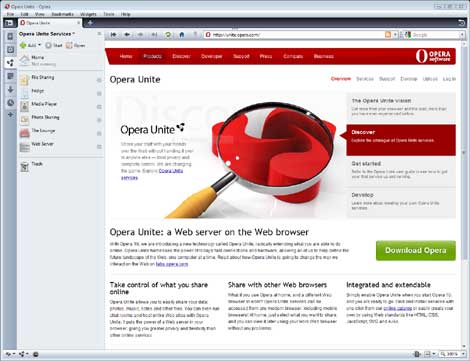
A look at the Opera Unite interface. The newest update includes a web server.
Has Opera reinvented the Internet? Or just come up with an interesting niche project for enthusiasts? Opera Unite transforms the web browser into a server, allowing users to share files and photos or even run a web site from within their browser (so long as the web site doesn't require PHP).
Opera is clearly targeting the web hosting and data center industry, hoping to build a business platform atop browser-based sites and services previously hosted by service providers. And it's using loaded terminology, with an introductory video attacking "servers belonging to strangers" and asserting that web sites are "at the mercy of middlemen who control the servers of the world."
"Our computers are only dumb terminals connected to other computers (meaning servers) owned by other people — such as large corporations — who we depend upon to host our words, thoughts, and images," writes Lawrence Eng, a product analyst for Opera, in a blog post introducing Unite. "We depend on them to do it well and with our best interests at heart. We place our trust in these third parties, and we hope for the best, but as long as our own computers are not first class citizens on the Web, we are merely tenants, and hosting companies are the landlords of the Internet."
Should the landlord be worried? Here's some reaction from around the web:
- CNet's coverage picks up the obvious downside: the security risks associated with running a server on your desktop or notebook. It notes that Unite doesn't incorporate SSL, and quotes Andy Buss, a senior analyst at Canalys, calling security based on the distribution of passwords was "an avenue to disaster."
- Larry Dignan from ZDNet thinks the concept of browser-based hosting may catch on: "This browser as a Web server concept is an innovation I see being picked up by other browsers. Can you imagine this approach bundled with Chrome, Gmail and other Google services? Wouldn’t Unite be great bundled as a Firefox add-on? Opera Unite will have a big impact, but the vision may be realized by browsers with more market share.
- Zoli Erdos at Cloud Avenue sees significant downside to the idea: "Do you really want to contribute to the underlying infrastructure of the Net? Opera says this is about taking our freedom back, but to me freedom means not having to worry about infrastructure at all. ... Oh, and there is the small issue of bandwidth."
- At InternetNews.com, Sean Michael Keener also wonders about bandwidth consumption. "I see no mention of it as a distributed or P2P type service in any of Opera's developer specs , which means that whatever it is you're hosting is hosted locally and using local bandwidth. For small items, that's fine but in the new era of metered bandwidth, I think users with large media/photo collections would be wise to think twice before hosting content on their own."
- Mashable says the issues extend beyond the bandwidth: "With Opera Unite, you should – ideally – be dependent only on your internet connection. Unfortunately, it doesn’t work like that, because a lot of the features cannot function without Opera’s servers, which somewhat undermines the point of the entire service."
My two cents? This might be interesting for the enthusiast crowd, but has significant limitations for any sites that have meaningful audiences. I doubt Opera Unite would ever be taken seriously as a business hosting platform, although it may create some interesting opportunities for developing social networking applications.
What do you think? Is browser-based hosting a threat to the hosting and data center industry? Have you say in the comments.


