• A Closer Look at the Kaleidoscope Supercomputer

    November 12th, 2008 : Rich Miller

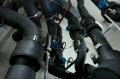
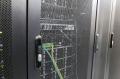
    Yesterday we wrote about the Kaleidoscope Project, which is being hosted in the Houston data center of managed hosting provider CyrusOne. Kaleidoscope harnesses 120 teraflops of computing power to generate digital images of oil reserves buried thousands of feet below the seabed. At right is a closer look at the Kaleidoscope installation, which is powered by 600 IBM PowerXCell 8i processors in eight cabinets that occupy just 22 square feet of floor space, resulting in a power load of 750 watts a square foot in that area of the CyrusOne data center. Kaleidoscope is a collaboration between Repsol; the Barcelona Supercomputing Center (home to the MareNostrum supercomputer); 3DGeo, a Houston-based imaging company formed by Stanford University professor and seismic imaging pioneer Biondo Biondi; and Stanford University’s Stanford Exploration Project (SEP).

    Read More »
  • Imaging the Earth’s Depths, at 750 Watts a SF

    November 11th, 2008 : Rich Miller

    The search for oil on the ocean floor begins on the data center floor. Long before drilling gets underway, the data-crunching commences in places like the CyrusOne data center in Houston, where the Kaleidoscope Supercomputer applies 120 teraflops of computing power to generate digital images of oil reserves buried thousands of feet below the seabed.

    Technology plays a critical role in finding oil and gas reserves at Spanish energy company Repsol YPF, which uses Kaleidoscope to identify drilling targets and reduce the risk of an expensive “dry hole.” Offshore wells typically cost at least $15 million, and some large platforms cost many times more. Computer modeling allows oil companies to analyze seismic data and produce 3D images that identify the best location and trajectory for drilling wells. These modeling applications require enormous computing power.

    Not every data center can handle the demands of supercomputers like Kaleidoscope, which is powered by 600 IBM PowerXCell 8i processors in eight cabinets that occupy just 22 square feet of floor space in the CyrusOne data center. That works out to 750 watts a square foot of power.

    “To meet the Kaleidoscope Supercomputer’s ultra-dense requirements and guarantee optimal installation and future-proof performance, we needed a colocation solution that delivered superior high-density capabilities across the board,” said Francisco Ortigosa, Repsol’s chief geophysicist and project leader.

    Read More »
  • Design Your Own Virtual Supercomputer

    November 11th, 2008 : Rich Miller

    Ever wondered what it’s like to design a supercomputer? Computer science students from Purdue University have created an online game that can provide a virtual taste of the experience. Rack-A-Node challenges players to design and operate a simulated research supercomputer. You must stay within your budget as you fill racks with hardware and complete computing tasks. But watch out for those power loads!

    The game was built to highlight Purdue’s participation in the Cluster Challenge at the SC ‘08 supercomputer conference on Nov. 15-21 in Austin, in which college teams compete to see who can build the best supercomputer in a day.

    “Rack-A-Node is a game that captures the essence of the supercomputer challenge,” says Kyle Bowen, informatics manager for Information Technology at Purdue. “The player has to optimize the supercomputer for the type of science being performed.”

    Read More »
  • RFID in the Data Center

    November 3rd, 2008 : Rich Miller

    Bank of America said last week that it is using radio frequency identification chips (RFID) to keep track of servers and other IT equipment, and is working to advance a standard for RFID tracking in financial data centers. The huge bank, which just got even bigger with its acquisition of Merrill Lynch, has deployed RFID in 14 of its 28 data centers, the company told RFID Journal (link via Zero Downtime).

    RFID allows information to be stored and retrieved on small devices called RFID tags, The technology is used in enterprise supply chain management, allowing companies to keep track of the location and status of products and orders. RFID has obvious utility in data center consolidations and migrations and in managing server sprawl in large organizations.  

    Read More »
  • Hardware Financing Terms Tightening

    October 27th, 2008 : Rich Miller

    Loans used to purchase servers and other data center hardware are becoming harder to find, which could leave some customers unable to finance IT purchases, or more inclined to buy from well-heeled vendors who can offer financing. The Wall Street Journal (subscription) reports:

    Troubles are brewing in the technology-financing business, the credit that greases many technology sales. Defaults on tech financings, loans that allow companies to purchase computers, software and other products, have spiked this year. The problems are surfacing after years in which such loans flowed freely. Now the banks and specialty lenders that most tech companies rely on to finance customer sales are retrenching, and financing terms are getting tougher. Some big tech companies, such as International Business Machines Corp., Oracle Corp. and Cisco Systems Inc., are stepping into the void — lending more of their own money to customers and taking on new risks.

    Who stands to benefit? IBM, Cisco and Oracle all have large customer financing operations. How bad is the problem? In September, 0.86% of equipment loans were written off as losses, up from 0.48% a year earlier, according to the Equipment Leasing and Finance Association, an industry group for 700 lenders. Tech-financings will reach $88 billion, about 14% of the total amount spent on computer hardware and software this year, estimates research firm IDC.

    Read More »
  • Sun, Cisco Veterans Team on Arista Networks

    October 23rd, 2008 : Rich Miller

    Sun Microsystems co-founder Andy Bechtolsheim is leaving the company to become chairman of Arista Networks, a maker of 10 Gigabit Ethernet switches, which has also recruited former Cisco Systems data center executive Jayshree Ullal as CEO. Arista, previously known as Arastra, announce their hiring today. Already on the story are Om Malik at GigaOm and Ashlee Vance at The New York Times, who reports that Stanford’s David Cheriton will also join Arista as chief scientist.

    Ullal headed Cisco’s Data Center 3.0 initiative, while Cheriton teamed with Bechtolsheim on early investments in Google (GOOG) and VMware (VMW).

    “While a number of companies sell competing gear, the pedigree of Arista’s management and its modular, easy-to-update software have given the four-year-old firm instant credibility in Silicon Valley,” The Times writes. Arista’s early customers include content delivery network BitGravity and Lawrence Livermore National Laboratory and International Center for Advanced Internet Research at Northwestern University (iCAIR).

    Read More »
  • Beautifying Your Blackbox

    October 23rd, 2008 : Rich Miller

    Data center containers aren’t going to win any beauty contests. Containers are all about horsepower, efficiency and speed-to-market, right? Perhaps, but they’re not all going to be parked in garages in mammoth data centers. A case in point: the Sun MD units housed at Sun’s Menlo Park campus, which Sun’s Katy Dickinson writes about in her blog post, Blackbox Landscaping.  

    “As a dedicated gardener, for the last six months I have been watching with interest the creation of a handsome landscape setting for the new Black Box now inside of Sun’s Menlo Park campus,” writes Dickinson, who has posted photos of the unusual setting. While some Sun MD customers are going with white containers, Sun has stuck with the original black version, as the green logo matches the plants and trees. Check it out.

    Read More »
  • Microsoft: PUE of 1.22 for Data Center Containers

    October 20th, 2008 : Rich Miller

    Microsoft says its testing shows that the data center containers it is installing in its new Chicago data center are extraordinarily energy efficient. The 40-foot shipping containers packed with servers can deliver a Power Usage Effectiveness (PUE) energy efficiency rating of 1.22, which rivals recent PUEs reported by Google. Microsoft’s Mike Manos revealed the PUE numbers in a blog post about the Chicago data center, which has just completed its first phase of construction.

    “The facility is already simply amazing and it’s a wonder to behold,” Manos writes of the $550 million, 500,000 square foot facility in Northlake, Illinois. “The joke we use internally is that this is not your mother’s data center.  You get that impression from the first moment you step into the ‘hangar bay’ on the first floor. The hangar’s first floor (pictured above) will house the container deployments and I can assure you it is like no data center you have ever seen.  It’s one more step to the industrialization of the IT world, or at least the cloud-scale operations space.”

    The 40-foot CBlox containers can house as many as 2,500 servers, and Manos said they allow Microsoft to achieve a density “10 times the amount of compute in a traditional data center.” The company says it will pack between 150 and 220 containers in the first floor of the Chicago site, meaning the massive data center could house between 375,000 and 550,000 servers in the container farm.   

    It also is helping Microsoft meet its goals for extraordinary energy efficiency. “Now I want to be careful here as the reporting of efficiency numbers can be a dangerous exercise in the blogosphere,” Manos writes. “But our testing shows that our containers in Chicago can deliver an average PUE of 1.22 with an AVERAGE ANNUAL PEAK PUE of 1.36. I break these two numbers out separately because there is still some debate (at least in the circles I travel in) on which of these metrics is more meaningful.  Regardless of your position on which is more meaningful, you have to admit those numbers are pretty darn compelling.” 

    Read More »
ARCHIVED ARTICLES