
-
Students Build Leading ‘Green’ Supercomputer

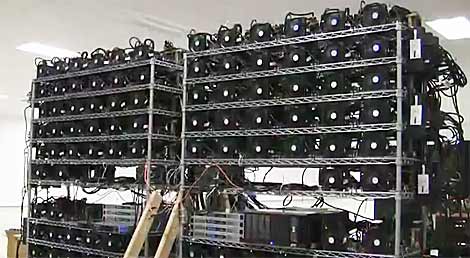
A GPU-powered computer cluster created by students at NCSA, which placed third in the Green 500 competition for energy-efficient supercomputing.
A team of students from the National Center for Supercomputing Applications (NCSA) have earned third place in the Green 500 list for energy efficient supercomputing with a 33 Teraflop system that was competition’s greenest self-built cluster. The NCSA entry finished behind a prototype system from IBM and Japan’s top supercomputer.
With guidance from Computer Engineering Professor Wen-mei Hwu, Computer Science professor Bill Gropp, and cluster experts at NCSA, students got hands-on experience building their own supercomputer with NVIDIA C2050 graphics-processing units. NVIDIA donated 128 C2050 units to the Illinois CUDA Center of Excellence, led by Hwu, and NVIDIA research scientist Sean Treichler spent time on campus helping to plan and build the cluster, which landed spot 403 on the Top500 list and then took third place when the Green500 was posted
“This project was very unique in that it gave students access to something few people ever have the opportunity to do,”said NCSA’s Mike Showerman. “We are already running some physics codes on the system with good performance results.”
This video shows the NCSA students assembling the system. It runs just under 2 minutes.
For more coverage of information about supercomputing, check out our High Performance Computing Channel. For additional video, check out our DCK video archive and the Data Center Videos channel on YouTube.
The Problem With the Top500 Supercomputer List | JetLib News
Posted November 19th, 2010[...] The Problem With the Top500 Supercomputer List November 19th, 2010 11:26 admin Leave a comment Go to comments Hello there! If you are new here, you might want to subscribe to the RSS feed for updates on this topic.angry tapir writes “The Top500 list of supercomputers is dutifully watched by high-performance computing participants and observers, even as they vocally doubt its fidelity to excellence. Many question the use of a single metric — Linpack — to rank the performance of something as mind-bogglingly complex as a supercomputer. During a panel at the SC2010 conference this week in New Orleans, one high-performance-computing vendor executive joked about stringing together 100,000 Android smartphones to get the largest Linpack number, thereby revealing the ‘stupidity’ of Linpack. While grumbling about Linpack is nothing new, the discontent was pronounced this year as more systems, such as the Tianhe-1A, used GPUs to boost Linpack ratings, in effect gaming the Top500 list.” Fortunately, Sandia National Laboratories is heading an effort to develop a new set of benchmarks. In other supercomputer news, it turns out the Windows-based cluster that lost out to Linux stumbled because of a bug in Microsoft’s software package. Several readers have also pointed out that IBM’s Blue Gene/Q has taken the top spot in the Green500 for energy efficient supercomputing, while a team of students built the third-place system. [...]
Back calculating from numbers in their press release, this supercomputer consumes about 36 KW, with equipment mounted on bread racks. Note the double rows of perforated floor tiles in front, and no visible efforts to separate hot air from cold air.
Data center designs like this often have PUEs over 2, approaching 3, so this supercomputer might need another 36-72 KW for cooling.
Maybe the Green 500 should multiply IT load by PUE before calculating the best performance per watt.
links for 2010-11-19 « Where Is All This Leading To?
Posted November 19th, 2010[...] Students Build Leading ‘Green’ Supercomputer « Data Center Knowledge (tags: cluster datacenter gpu nvidia tesla) [...]
Knightlink
Posted November 22nd, 2010From my understanding of green computing is to use less energy but produce the same results, from what I can see here is they are basically the same build as a rack mount but without a housing. Still have the 128 power supplies creating excess heat that is not needed in this build. Looks interesting…
Rocky, thanks for the comment! As for the PUE, the current projection for the facility is 1.1 or 1.2 — you can read more on our website: http://www.ncsa.illinois.edu/AboutUs/Facilities/npcf.html
superputers – Latest superputers news – Good Vibrations: Stanford Engineers Put A Damper on ‘Aeroelastic Flutter’
Posted March 26th, 2011[...] Tech built a supercomputer using 324 Mac Pros. Students from the University of Illinois's National Center for Supercomputing Applications won an environmental award for their home built energy conserving supercomputer in [...]
super computer – The Air Force's Newest Supercomputer – Yahoo! News
Posted April 3rd, 2011[...] Tech built a supercomputer using 324 Mac Pros. Students from the University of Illinois's National Center for Supercomputing Applications won an environmental award for their home built energy conserving supercomputer in [...]
Building A Cloud-Savvy Model for TCO and ROI
How Storage is Shaping The Cloud Data Center
Bringing Colo to the Customer: Modular Gets Local
Microsoft’s $1 Billion Data Center


November 19th, 2010