
The Green Data Centers Channel is sponsored by Rittal

  • NetApp Unveils Green Data Center

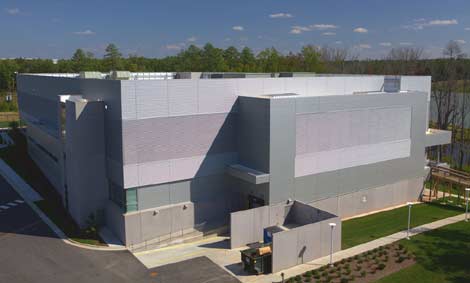
    The exterior of the new NetApp data center in Research Triangle Park, North Carolina.

    The exterior of the new NetApp data center in Research Triangle Park, North Carolina.

    Today NetApp (NTAP) is opening the doors to its new energy-efficient data center at its campus in Research Triangle Park (RTP), North Carolina. The new facility will enable NetApp to consolidate its engineering facilities into a global dynamic lab (GDL) and will house NetApp’s IT operations.

    The 132,000 square foot facility houses a 36,000 square foot data center supporting 2,166 racks of IT equipment with a designed power load of nearly 25 megawatts.

    Estimated PUE of 1.2
    The NetApp data center was designed with numerous features to reduce the energy needed to power and cool those servers, which the company estimates will result in a Power Usage Effectiveness (PUE) rating of 1.2.

    The PUE metric (PDF) compares a facility’s total power usage to the amount of power used by the IT equipment, revealing how much is lost in distribution and conversion. A rating of 1.2 would place the NetApp facility among the most efficient data centers in the world, in roughly the same class as facilities operated by Google and Microsoft.   

    NetApp estimates that its focus on energy efficiency will generate savings of $7.3 million a year on the company’s power bill and reduce its CO2 output by 93,000 tons a year – the equivalent of removing 15,400 cars from the road.

    The energy effiency features at the RTP data center include:

    • Running Warmer: NetApp says its average supply air temperature will be 74 degrees, slightly higher than the 68 to 72 degree range seen in many data centers. 
    • Airside Economization: The data center will be cooled using just outside air (free cooling) for an estimated 67 percent of the year.
    • Pressure Control: Modulating fans, based on NetApp’s proprietary technology, supply pressure-controlled rooms and regulate the volume of air to avoid oversupplying air and wasting energy.
    • Cold aisle containment: The cold and hot air aisles are isolated to protect supply air temperatures from being affected by hot air returning from the racks.
    • Overhead air distribution: Instead of pumping cold air up through a raised floors, overhead air distribution takes advantage of cold/hot air buoyancy and eliminates ductwork and energy needed to power fans.

    NetApp said its software will help improve data management and storage efficiency in the data center. The company will use virtualization to build a private cloud environment to provide virtual access for NetApp engineering labs around the world.

  • Bob L

    Posted October 7th, 2009

    2166 racks in 36,000 square feet? that is one rack per 16.6 square feet. Seems pretty tight?

    Joshua Konkle

    Posted October 7th, 2009

    Bob – yes it’s really tight. We use pressurized-monitored cool isle technology defined and innovated at NetApp. As enterprises and services providers build out their clouds to ISO20K – they can be sure to get trusted advice from NetApp.

    Following are key features that will contribute to the RTP data center’s outstanding energy efficiency:

    * 74° F average supply air temperature: Using a higher temperature threshold on supply air (74° F instead of 55° to 60° F) allows NetApp to dramatically reduce cooling costs.

    * Airside economizer: The data center is cooled by using just outside air (free cooling) 67% of the time during the year.

    * Pressure-controlled room: Modulating fans, based on NetApp’s proprietary technology, supply pressure-controlled rooms and regulate the volume of air to avoid oversupplying air and wasting energy.

    * Cold aisle containment: The cold room separates the cold and hot air streams to protect supply air temperatures from being affected by hot air returning from the racks.

    * Overhead air distribution: Instead of pumping cold air up through the floors (raised floors), overhead air distribution takes advantage of cold/hot air buoyancy and eliminates ductwork, reducing the energy needed for fans.

    Bob L

    Posted October 7th, 2009

    two questions Joshua…
    Air side? Is that roof top units or something custom like what ADC did?
    Any chance of some pics? Most interested in your containment design and the air side setup.
    Thanks

    Bruno

    Posted October 7th, 2009

    Could you provide us with an indication of resilience level (Tier) of the facility to go with those PUE numbers?

    Ty S

    Posted October 8th, 2009

    Joshua

    Are you looking at enthalpy when in economizer mode, the picture shows that the building is next to a pond of some size? One would assume that the other side of the building is the chiller yard. The picture looks like you have Trane equipment on the roof is that what you are using for the fresh air intake.

    The 74 degree inlet air temp that’s nice, but the 94 degrees in the hot row, that sucks to work in. The nice thing with the higher temps that the Data Centers are going to; the CRAH/ CRAK units are no longer are removing latent heat from the air. This allows for better efficacies numbers.

    Mark S

    Posted October 8th, 2009

    Most of the facility is straight utility power. the PUE is an annualied expected performance. 1/6 of the facility is Tier 3 and the PUE is expected to be in the range of 1.25 for the Tier 3 space.

    94 degrees is the target hot aisle temp, we reset supplies higher when when the hot aisles on either side of the cold room are unoccupied which actually is the majority of the time since this is a building that does not have many occupants even during normal working hours. Keep in mind 2/3 of a normal week is outside of business hours. When outside ambients are colder we can lower the supply and corresponding hot aisle as desired at no cost.

    We actually do measure wet bulbs for selecting mode of operating our economizer systems.

    There are two primary air handlers per cold room that sit directly above the cold room in a mezzanine (the second floor with damper/lover system). Each unit is 46,000 cfm and rated at approximately 100 tons of refrigeration. They are commercial/catalogue indoor rated units with a mixed air chamber and cooling coil. The outside air intake is from the roof.

    Add Your Comments

Sign up for the
Data Center Knowledge Newsletter

Submit

Get daily email alerts direct to your inbox.

ARCHIVED ARTICLES